

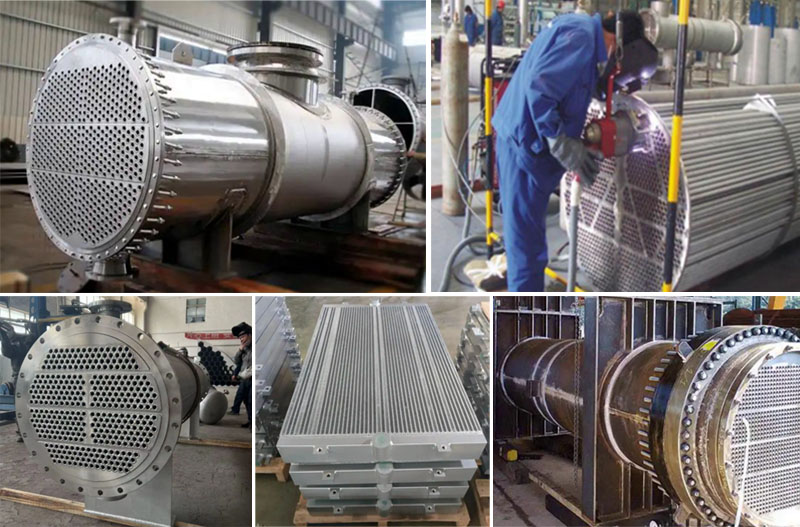
换热器是工业生产中实现热量传递的关键设备,广泛应用于石油、化工、食品、制药等领域16。其核心功能是通过冷热流体间的热量交换,实现加热、冷却、冷凝或蒸发等工艺需求。
一、主要分类与特点
1、按结构形式
管壳式换热器:结构简单、操作可靠,是应用最广泛的类型。
板式换热器:传热效率高(可达管式的3倍),但承压能力较低。
螺旋板式换热器:体积紧凑,适合小流量工况。
夹套式换热器:结构简单,但传热效率有限。
2、按工艺用途
包括加热器、冷凝器、蒸发器、再沸器等,例如蒸发器多用于蒸馏和脱水,而换热器侧重温度调节
二、典型应用场景
化工行业:反应物料加热、溶剂蒸发。
食品加工:杀菌、烘干及设备消毒。
能源领域:电厂余热回收、天然气脱水。
环保工程:工业废水处理中的热量回收。
Heat exchanger is a key equipment for heat transfer in industrial production, widely used in fields such as petroleum, chemical, food, and pharmaceuticals. Its core function is to achieve process requirements such as heating, cooling, condensation, or evaporation through heat exchange between cold and hot fluids.
一、 Main Categories and Characteristics
1. According to the structural form
Shell and tube heat exchanger: With a simple structure and reliable operation, it is the most widely used type.
Plate heat exchanger: High heat transfer efficiency (up to 3 times that of tube type), but low pressure bearing capacity.
Spiral plate heat exchanger: compact in size, suitable for low flow conditions.
Jacket heat exchanger: simple structure, but limited heat transfer efficiency.
2. According to the process purpose
Including heaters, condensers, evaporators, reboiler, etc., for example, evaporators are mostly used for distillation and dehydration, while heat exchangers focus on temperature regulation
二、 Typical application scenarios
Chemical industry: Heating of reaction materials and evaporation of solvents.
Food processing: sterilization, drying, and equipment disinfection.
Energy sector: Power plant waste heat recovery, natural gas dehydration.
Environmental engineering: Heat recovery in industrial wastewater treatment.